So, what's been happening down in the mud? A previous entry has described the visit from Japan, organised by the Ramsar Centre of Japan. Thrilled to say that now my MSc is completed (mid Sept). So for the last few weeks a lot of digging has been committed, and the plant data have been charted (next blog).

As per
a previous update what Jim and I discussed doing was widening and deepening the start of the main channel (2) from the sluice gate across the centre of the pond. This has been done, and produced some more hills, including A2, B2 and D2 (yes, we've gone round the alphabet already). Much has been learnt during this process. It's been hard slow work as the channel is already quite deep. Thus taking the sides back and sloping them over means shifting a huge amount of soil. Often there are a series of drainage holes on the surface near the edge of the channel.
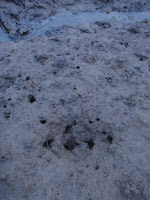
These holes mean that any soil below is not going to be that strong or stable. Therefore the subsoil has to be dug out. The implication of this is that sometimes the sides of a channel have to be lent right back to remove this unstable soil, (ie a LOT of digging) and to keep the weight off what is left. Otherwise the sides of the channel collapse inwards. The picture below is looking up the channel, which I was standing in at the time of taking this picture. At the top is what the original channel looks like, unaltered. The pool in the middle is an example of the excavation, the new channel floor being two feet lower than the current channel bottom. Near to me, the sides have collapsed inwards.
The soil itself has a very high clay content. Often it was possible to cut pieces out like blocks of cheese.

There have also been some amazing colours in the clay; yellows, light blues and reds.

Though this might look like strata of sand, a 'finger test' of the coloured material revealed that it had the same consistency as normal clay.
Needless to say, because this channel is the lowest point on the site, it could only be worked at the lowest tides. It is only possible to work from the sluice gate upwards, not working downstream. However, because the total volume of water leaving the pond during any one tide is not great, the bottom of these new channels becomes filled with very fine silt and clay, rather than being scoured by the movement of the water.
When the tide was too high to permit work in Channel 2, a new branch (2D) has been excavated. 2 denotes that it drains into the main channel running across the pond. D as it's the fourth sub-channel to be created. 2D has been excavated as carefully as possible, digging out loose soil in the slopes, sloping the sides over as much as possible, trying to keep the hills made with the spoil back from the edge of the channel so their weight does not cause a cave-in and not excavating in a straight line. Below is an early picture of 2D coming to life, with some interesting if unmoved woodwork in the middle.

The new hills have been labelled and marked up on the map at the top of this blog. Some of them will be left blank to monitor natural regeneration. Some have been dibbled with seeds and propagules. And some have received test transplants from home. Over the course of this year I've been collecting seeds and growing them at home, to be able to watch their development. It has allowed me to experiment with various ideas, and look at tolerances. As I'm going on holiday Oct 22nd for a while, these mangroves are now being transported to the site - in some style, I might add.

Hill Y has received a pot of
Rhizophora apiculata (above) from home, all of which had damaged buds. They have managed to recover from this early trauma and grow normally.

Hill R has taken three
Nypa fruticans palm plants. These are a species the local people use for their own livelihoods, so the site, once fully established, will have a good proportion of
Nypa. These have been grown at home, and will be measured, monthly with the other hills that are monitored.

Two friends are visiting me from the UK. Over the weekend we will go to BLD and do the monthly measuring of all the plants being monitored. In the subsequent blog some of the initial data will be presented. In the meantime Rossi is back on his bike this weekend at Estorill, Portugal. Go Rossi!
 After a brief opening speech by the leader of the Taesobahn (sub-district authority), K Donnapat got the talk going with the issues surrounding climate change. K' Donnapat is a natural with the children and seems to thrive off their energy.
  After a coffee break, the group of children was divided into three. One of these groups was lead by K' Ning of Mangrove Action Project. A professional educator and community development specialist, she engaged the children in discussions about mangrove tree adaptations to inter-tidal life and mangrove food webs.
 K' Donnapat's devised an educational snakes and ladder's game, where the children had to answer questions about wetlands to be able to move up and down the board.
 The third group worked with K' Manoon from the the Dept for Marine and Coastal Resources', who talked about uses and outputs from mangroves.
 When the group came back together, Jim from Mangrove Action Project covered the problems related to plastic bags, the fact that they take years to degrade, and are often used only once, for just a few minutes. To give the children a permanent reminder, each student was given a cloth bag to keep.
 After lunch at the school we asked the children to draw what they wanted their mangroves to look like in the future and then discuss their thoughts in front of everyone else.
 After the drawings were presented we moved to the rehabilitation site, where community leaders Bang Dol and Bang Mardee talked with the local children about their experiences of cutting all the mangrove for charcoal in the 1990s and the resulting disastrous effects.


 The good news was that not only were almost all the plants doing well, but the last experiment with Sesuvium on E2 was also thriving.


