The beginning of September saw some pretty terrible weather in Krabi, lightened by visitors from Japan. This time the group was under the auspices of the Reiko and Musha (below)from
Ramsar Centre of Japan,

and supported by Emiko and Tomoko from the
Environment Restoration and Conservation Agency of Japan and Dr Sansanee from Mahidol University. Their student group of undergrads and postgrads included an interesting mix of subjects including law, architecture, agriculture and fresh water lake systems. The Krabi visit was only one small part of a gruelling three week tour covering selected parts of southern Thailand, followed by a similar tour around Bangladesh.
In three days they managed to squeeze a lot into their visit. First was a walk around the ‘Two Waters’ Ecotone, where a freshwater forest gives way to a brackish water system.

Then a visit to The Ammartpanichnukul School in Krabi to hear from the students about their mangrove work, and for the Japanese guests to present some aspects of Japanese life.

The school then treated us to a great lunch in a nearby restaurant. Krabi Provincial Office played host that afternoon, and the group met the leaders of the KPO and K’ Asae, Director of Wetlands International – Thailand Office.


In the evening we were all treated to a delightful dinner by K’ Sajjaporn from KPO.
The next day the group took a boat trip around the Krabi mangroves

and out as far as the bird watching towers. Sadly the weather was not kind, but the visitors were well kitted out with wet weather gear. Bang Non, our boatman and a conservation worker within his own community, presented what he had done to collect and recycle waste from his village in Klong Prasong, helped by Dr Sansanee, and also put on a fabulous lunch, despite it being Ramadan.

In the afternoon the Wetlands team presented the work done at Bang Lang Da, before travelling to the village. Bang Don explained to the group the crab rearing and fattening process before looking at the rehabilitation pond.

Sadly the rains returned so we beetled back to the vans and had banquet with the great and the good of Krabi, hosted by the RCJ.
On their last day we excellent dimsum, again with K Sajjaporn, before an informal trip to the morning market

and an OTOP batik shop. Thus, sadly, our new Japanese friends left for Bangkok, and the next day Bangladesh. Come back soon.
 At the end of January 2011 we had our final visit by TEI together with members of the APFED council. Jim from MAP managed to join, plus K Donnapat of WI and Bang Dol of the local village. Our site friend Prof Sanit from TEI, who was in fine form, led his NGOs team including Dr Qwan, a previous visitor.


 As expected Prof Sanit had many insightful comments, questions and was very happy with the progress.
  As before, the TEI team took great interest in the activities of the whole village and how they were getting on. So the meeting was joined by the BLD crab rearing / conservation team and the discussions broadened to other topics.
 Kindly, part of the TEI team visited the night before (below) to document the activities and technical details. Therefore most of the work could be discussed in the shade of Bang Dol's house, rather than slopping through the mud in 34 degree heat.
 After a brief opening speech by the leader of the Taesobahn (sub-district authority), K Donnapat got the talk going with the issues surrounding climate change. K' Donnapat is a natural with the children and seems to thrive off their energy.
  After a coffee break, the group of children was divided into three. One of these groups was lead by K' Ning of Mangrove Action Project. A professional educator and community development specialist, she engaged the children in discussions about mangrove tree adaptations to inter-tidal life and mangrove food webs.
 K' Donnapat's devised an educational snakes and ladder's game, where the children had to answer questions about wetlands to be able to move up and down the board.
 When the group came back together, Jim from Mangrove Action Project covered the problems related to plastic bags, the fact that they take years to degrade, and are often used only once, for just a few minutes. To give the children a permanent reminder, each student was given a cloth bag to keep.
 After lunch at the school we asked the children to draw what they wanted their mangroves to look like in the future and then discuss their thoughts in front of everyone else.


 First we took a boat trip round the estuary mangroves. To the bemusement of our regular boatman Bang Non we pulled in at many places to look at trees, pull off leaves, head-butt bulbous fruits and photograph flowers. [That low scrubby bush was Brownlowia tersa, Claudio. Sorry.]
  Then to lunch. Monica is happy to indulge in all Thai foods but Claudio is less catholic in his consumption... unless we were in an Italian restaurant, of which Krabi has at least three good ones. Lunch thus became another Italian lesson of slow eating, delicious food and tiny coffees. The meal concluded we headed to the site at Bang Lang Da.

 We also discussed the idea with Bang Don of trying to combine crab fattening in semi-submerged boxes in the pond. Traditionally combining the two properly has been tricky as mangroves need a daily flush of water, where most crab ponds have impounded water. Watch this blog.
 At the end, Claudio looked at the site and the digging and in deliberate and perfect English said to me, “You are a mud lobster!” From anyone else this might be an insult. From Claudio it was an honour as well as being perfectly true as
  Dinner was at a Thai restaurant called Gotung. Claudio performed his dinner table trick of eating raw spring onions in lime juice as way of adding a bit of oral aggression to fried rice.
 Well accustomed to working with communities in Thailand, Barry spent a good while with the fine folks of the village at the coffee shop, explaining to the assembled bemused what the kitchen sieve and the ziplock bags were for.
 So with my breaking shovel (“Welded, na!! Really strong, jing jing!!” Phaa!) creaking like 1970’s garden furniture, we dug up various holes, crab casts, channel bottoms and sieved, photographed and noted. Sadly the pond snakes failed to make a gala appearance. But there was plenty to keep us occupied.
 Thus we headed home with some bizarre polychaetes in a bag, for further study. After a feed at the night market and a modest beer we photographed what turned out to be a pair of spoon worms, performing stomach yoga.
  Finally, the ever-benevolent Bareee (as pronounced in Thai) released our exercise troupe into a nearby stream.
 Thank you, Barry for your expertise and good humour. See you again soon.

 At BLD we watched in amazement as a couple pulled a bucket of fish out of a channel that had been dug next to the sluice gate, having netted off the pond at high tide.
 Thank you for visiting, Tom. Please come back soon, and bring your wife.


 Professor Sanit was very supportive of the effort to facilitate natural regeneration, immediately undertood the particular site challenge we faced and encouraged the team to add a greater scientific component to the work. And like the pro that he is, he and his team spent plenty of time with the local community and took a great interest in Bang Don's crab culturing pond.
  A great lunch was hosted by Bang Don and his family at his home before our visitors flew back to Bangkok. Thank you for your visit.

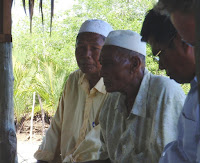 Bang Don (left above) presented the work of his crab group and answered a variety of questions, organisational and technical, posed by the visitors, some of whom did the same thing back home.
 For their part, despite it being the last day of what must have been a gruelling tour, they took notes assiduously, and asked very pertinent questions.
 Having thanked Bang Don, and the other members of the crab group who supported him, the group moved onto the mangrove site. K' Donnapat and I did our best to explain our objectives, and why a former pond now looked like a golf driving range.


