
 |
| Site Survey, March 2009. No natural regeneration |
This site was chosen as it was a typical aquaculture pond, carved out of former mangroves. The pond had been abandoned for 5-7 years and the mud walls round the blocked sluice gate had eroded, thus allowing tidal flushing for 2-3 years before the project started. However, despite the availability of propagules and seeds, the pond floor was not regenerating. A site survey supported the hypothesis that the pond was not regenerating due to the substrate being too low, relative to sea level – almost Watsonian (1928) mudflat. Mangroves surrounding the pond were growing at levels higher than the pond floor. Therefore the restoration part of the project attempted to correct this by raising the height of some of the substrate and improve the drainage.
Hills Stable, Channels Less So
 |
| Feb 2010. |
Most of the effort has been focused on repairing the topographical damage - widening and lowering the channels across the pond to improve drainage and with the spoil creating a series of hills, of drier and firmer substrate. Approximately 32 hills have been dug and 60m of channel improved or dug. Each of the hills is about 1m high by 3m across, weighing about a tonne. This has provided more substrate at the appropriate height for mangrove growth and better drained soil. Many of these hills have quickly been colonised by crabs.
Despite misgivings by local people, once settled, and water squeezed out of the clay by its own weight, the hills remained relatively stable losing between 10-20cms height over 18 months. For example, Hill A, the first hill produced, has settled and lost only 16cms in height, between March 2009 and Jan 2011. Though the sample is small, vegetated hills seemed to be more resistant to erosion, possibly from the protection the leaves offer from the rain.

Digging the channels and producing the hills was hard work, and required the sides of the hills to slope only gently, otherwise the sides would buckle out. Thus producing much higher hills required disproportionately larger amounts of digging. However this is a viable method for amending topography changed by pond conversion, and could be a livelihood opportunity[1], or done mechanically.
The channels, on the other hand, were less stable. Testing revealed that channel sides needed to be sloped at very shallow angles, and nearby surface ‘sloppy’ mud skimmed off and piled onto the hill. The pond contained so much fine clay material, and the process of working and walking in the channels churned up the mud so much, that the channels tended to fill in more quickly than the hills subsided and eroded.
Plant Growth from Dibbled Propagules
A random sample of hills was dibbled with various mangrove propagules. The first hill to be dibbled[2] was Hill C. This received Rhizophora apiculata, dibbled on 22nd March 2009. The chart below shows Hill C’s encouraging and continued growth. It also shows that though propagules were dibbled around the base of the hill, mid-way up and on top of the hill, the heights attained by the surviving plants suggest that lower plants were slightly taller than the higher and mid-level plants.


This pattern of good growth on the hills is repeated for Ceriops tagal and Bruguiera cylindrica. Nypa fruticans has been slower to establish itself, and some of the Nypa hills have failed (eg X, R), but is still growing on Hill H and D, average height 90cms.
Growth Comparisons
To compare dibbling on hills to dibbling into unaltered pond floor, four ‘Test Planting’ plots were established. TP1&2 received R. apiculata propagules. Much to everyone’s surprise both these plots thrived, despite very little other natural regeneration on the pond floor of any species.

Initially, the TP plants struggled up quickly to gain more height, at the expense of far fewer leaves, and leaves that were 50% of the size of those on Hill C. However, almost two years after the event, the leaf size difference has largely gone. Similarly, TP1 average height is 100cm and TP2 110cm to Hill C’s 95cm average, so now all about similar height.
Dibbling Avicennia marina on Hill P initially produced limited growth of approximate 10 plants from 50 propagules around the base of the hill. In the adjacent Test Planting plot 4 where 50 A. marina propagules were dibbled into the soil, only one plant survived. Eventually, all the A. marina died on hill and plot. Predation by crabs is suspected.
B. cylindrica was dibbled into Hills F and L. Ceriops tagal was installed in Hill E (below). Both were dibbled into Test Plot 3. Sadly all the B. cylindrical on Hill L died, but both E (av. height 34cm) and F (av. height 60cm) survived. Compared to the Test Plot 3 dibbled directly into the pond floor, growth seems to be marginally easier on the hills.
Debris. A Possible Cause of Plant Death

Of constant concern was debris that floated into the pond from the outside. Hills E (above) and L appeared to have sustained impact damage, and the tops of both hills had been cleared of dibbled plants, but the plants lower down the slopes surviving. There was a lot of debris in the corner of the pond, and occasionally with a high tide and change of wind direction, this would shift to the other end (see below). It is suggested that this movement, and debris in general, killed off some of the plans, and also reduced the amount of successful natural regeneration within the pond.

Control Plots Remained Empty

Seven 3x3m Control Plots were installed over the pond to monitor natural regeneration on the pond floor. Though the rods demarking the plots were eventually stolen, the plots remained empty.
And Almost No Natural Reneg On the Hills So Far
And Almost No Natural Reneg On the Hills So Far
It was anticipated that with hill substrate at a more appropriate height for mangroves, some propagules and seeds would volunteer onto a hill and start to grow. The site is not propagule-limited: towards the end of the rainy season many seeds of several species arrive in the pond. At the top end of the pond, which was on average 30 cm higher than the lower parts of the pond near the sluice gate, many propagules were seen to start growing in the pond floor, but would die off after a few months. The reason for this die-off is not clear as pH was never more acidic than 6, and salinity always between 22-35ppt. Leaves on the new arrivals did not seem to be suffering unduly from pest damage, though there was a considerable amount of water scum deposited on the leaves. Thus a suggestion is that the regeneration at the top of the pond was also damaged by debris floating over the pond.
Only one Xylocarpus moluccensis arrived on a hill (C) and set root.

[1] MAP and WI-T have successfully used local labour to excavate another site in at Ban Talay Nok, Phang Nga province. The link goes to a short film of the project. http://www.youtube.com/watch?v=qKL3KJE3Xsw
[2] ‘Dibbling’ is a process of inserting a seed or propagule directly into the mud, rather than either scattering them on the water, or growing the seeds up in a nursery. This was done to keep all costs to a minimum, and was a technique a village conservation team could easily repeat.

 The good news was that not only were almost all the plants doing well, but the last experiment with Sesuvium on E2 was also thriving.

 As per
 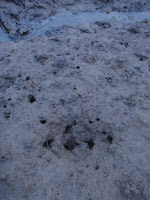 These holes mean that any soil below is not going to be that strong or stable. Therefore the subsoil has to be dug out. The implication of this is that sometimes the sides of a channel have to be lent right back to remove this unstable soil, (ie a LOT of digging) and to keep the weight off what is left. Otherwise the sides of the channel collapse inwards. The picture below is looking up the channel, which I was standing in at the time of taking this picture. At the top is what the original channel looks like, unaltered. The pool in the middle is an example of the excavation, the new channel floor being two feet lower than the current channel bottom. Near to me, the sides have collapsed inwards.
 There have also been some amazing colours in the clay; yellows, light blues and reds.
  Though this might look like strata of sand, a 'finger test' of the coloured material revealed that it had the same consistency as normal clay.
 The new hills have been labelled and marked up on the map at the top of this blog. Some of them will be left blank to monitor natural regeneration. Some have been dibbled with seeds and propagules. And some have received test transplants from home. Over the course of this year I've been collecting seeds and growing them at home, to be able to watch their development. It has allowed me to experiment with various ideas, and look at tolerances. As I'm going on holiday Oct 22nd for a while, these mangroves are now being transported to the site - in some style, I might add.
 Hill R has taken three Nypa fruticans palm plants. These are a species the local people use for their own livelihoods, so the site, once fully established, will have a good proportion of Nypa. These have been grown at home, and will be measured, monthly with the other hills that are monitored.
  Two friends are visiting me from the UK. Over the weekend we will go to BLD and do the monthly measuring of all the plants being monitored. In the subsequent blog some of the initial data will be presented. In the meantime Rossi is back on his bike this weekend at Estorill, Portugal. Go Rossi!


 Well accustomed to working with communities in Thailand, Barry spent a good while with the fine folks of the village at the coffee shop, explaining to the assembled bemused what the kitchen sieve and the ziplock bags were for.
 So with my breaking shovel (“Welded, na!! Really strong, jing jing!!” Phaa!) creaking like 1970’s garden furniture, we dug up various holes, crab casts, channel bottoms and sieved, photographed and noted. Sadly the pond snakes failed to make a gala appearance. But there was plenty to keep us occupied.
 Thus we headed home with some bizarre polychaetes in a bag, for further study. After a feed at the night market and a modest beer we photographed what turned out to be a pair of spoon worms, performing stomach yoga.
  Finally, the ever-benevolent Bareee (as pronounced in Thai) released our exercise troupe into a nearby stream.
 Thank you, Barry for your expertise and good humour. See you again soon.

