The beginning of September saw some pretty terrible weather in Krabi, lightened by visitors from Japan. This time the group was under the auspices of the Reiko and Musha (below)from
Ramsar Centre of Japan,

and supported by Emiko and Tomoko from the
Environment Restoration and Conservation Agency of Japan and Dr Sansanee from Mahidol University. Their student group of undergrads and postgrads included an interesting mix of subjects including law, architecture, agriculture and fresh water lake systems. The Krabi visit was only one small part of a gruelling three week tour covering selected parts of southern Thailand, followed by a similar tour around Bangladesh.
In three days they managed to squeeze a lot into their visit. First was a walk around the ‘Two Waters’ Ecotone, where a freshwater forest gives way to a brackish water system.

Then a visit to The Ammartpanichnukul School in Krabi to hear from the students about their mangrove work, and for the Japanese guests to present some aspects of Japanese life.

The school then treated us to a great lunch in a nearby restaurant. Krabi Provincial Office played host that afternoon, and the group met the leaders of the KPO and K’ Asae, Director of Wetlands International – Thailand Office.


In the evening we were all treated to a delightful dinner by K’ Sajjaporn from KPO.
The next day the group took a boat trip around the Krabi mangroves

and out as far as the bird watching towers. Sadly the weather was not kind, but the visitors were well kitted out with wet weather gear. Bang Non, our boatman and a conservation worker within his own community, presented what he had done to collect and recycle waste from his village in Klong Prasong, helped by Dr Sansanee, and also put on a fabulous lunch, despite it being Ramadan.

In the afternoon the Wetlands team presented the work done at Bang Lang Da, before travelling to the village. Bang Don explained to the group the crab rearing and fattening process before looking at the rehabilitation pond.

Sadly the rains returned so we beetled back to the vans and had banquet with the great and the good of Krabi, hosted by the RCJ.
On their last day we excellent dimsum, again with K Sajjaporn, before an informal trip to the morning market

and an OTOP batik shop. Thus, sadly, our new Japanese friends left for Bangkok, and the next day Bangladesh. Come back soon.

 As per
 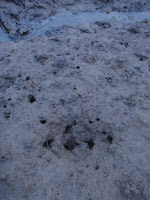 These holes mean that any soil below is not going to be that strong or stable. Therefore the subsoil has to be dug out. The implication of this is that sometimes the sides of a channel have to be lent right back to remove this unstable soil, (ie a LOT of digging) and to keep the weight off what is left. Otherwise the sides of the channel collapse inwards. The picture below is looking up the channel, which I was standing in at the time of taking this picture. At the top is what the original channel looks like, unaltered. The pool in the middle is an example of the excavation, the new channel floor being two feet lower than the current channel bottom. Near to me, the sides have collapsed inwards.
 There have also been some amazing colours in the clay; yellows, light blues and reds.
  Though this might look like strata of sand, a 'finger test' of the coloured material revealed that it had the same consistency as normal clay.
 The new hills have been labelled and marked up on the map at the top of this blog. Some of them will be left blank to monitor natural regeneration. Some have been dibbled with seeds and propagules. And some have received test transplants from home. Over the course of this year I've been collecting seeds and growing them at home, to be able to watch their development. It has allowed me to experiment with various ideas, and look at tolerances. As I'm going on holiday Oct 22nd for a while, these mangroves are now being transported to the site - in some style, I might add.
 Hill R has taken three Nypa fruticans palm plants. These are a species the local people use for their own livelihoods, so the site, once fully established, will have a good proportion of Nypa. These have been grown at home, and will be measured, monthly with the other hills that are monitored.
  Two friends are visiting me from the UK. Over the weekend we will go to BLD and do the monthly measuring of all the plants being monitored. In the subsequent blog some of the initial data will be presented. In the meantime Rossi is back on his bike this weekend at Estorill, Portugal. Go Rossi!
