 Last week we got the great news that finally Balaji has been awarded his doctorate from Bharathidasan University, Trichy, India. Balaji visited Krabi and the site 9th May and is the director of OMCAR Tamil Nadu. Many congratulations, Dr Balaji.
Showing posts sorted by relevance for query balaji. Sort by date Show all posts
Showing posts sorted by relevance for query balaji. Sort by date Show all posts
Monday, August 17, 2009
Dr Balaji, at last
Last week we got the great news that finally Balaji has been awarded his doctorate from Bharathidasan University, Trichy, India. Balaji visited Krabi and the site 9th May and is the director of OMCAR Tamil Nadu. Many congratulations, Dr Balaji.

Sunday, May 17, 2009
Balaji's visit
Balaji is an amazing man. He's motorbiked around India to promote awareness and protection of the coastal ecosystem. He's kayaked the length of Palk Bay  (the bite of coastline shown here, hairily close to the frightening end of Sri Lanka) over three months stopping off at various villages to preach the gospel of coastal zone conservation.
  Within a viva of receiving his PhD in seagrass monitoring he's also set up OMCAR, his own NGO that is based in, and works closely with, two or three communities on the Tamil Nadu coast (embedding like this is the best way to ensure development projects really work), sorted out core funding support from DEEPWAVE, a German NGO, (a rare trick that every NGO fantasized about achieving) and is about to get married in a few weeks time.
(the bite of coastline shown here, hairily close to the frightening end of Sri Lanka) over three months stopping off at various villages to preach the gospel of coastal zone conservation. Within a viva of receiving his PhD in seagrass monitoring he's also set up OMCAR, his own NGO that is based in, and works closely with, two or three communities on the Tamil Nadu coast (embedding like this is the best way to ensure development projects really work), sorted out core funding support from DEEPWAVE, a German NGO, (a rare trick that every NGO fantasized about achieving) and is about to get married in a few weeks time.We met at Robin Lewis' mangrove rehab training workshop (2005) and have kept in touch ever since. So it was wonderful to show him round Krabi, hear what he's been doing in India and take him to the pond. In true Balaji style he leapt straight in and started digging.  Please come back and see us soon. We wish you all the best for your wedding.
Please come back and see us soon. We wish you all the best for your wedding.Sunday, May 31, 2009
Daily Mud - Fashion Week Hits the Mangroves
"Still, a chap ought to look smart
in front of the men, don't you think?"
Lt Gonville Bromhead, played by
Michael Caine, in Zulu, 1964, just before
being sliced up into pet food by 6,000
angry warriors
It was upsetting when it happened, like a pet dog finally dying, but having made the decision, it was clearly the right thing to do. No doubt to the relief of the talented and quizzical seamstress, K’Nee, who had sutured them back to life and respectability many times, the faithful and crucially nylon, fast drying shorts that I always wore to the mangroves finally endured their last trip & rip, while in the brown stuff at Ban Tale Nok, Phang Nga province. A rose-like climber ensnared the shorts, ripping them from top to tail, and slicing my thigh like a barbed wire cheese cutter.
Pity. So before a more detailed and hopefully useful report on Ban Tale Nok, some thoughts on sartorial elegance in the filth. Consider the presence of sun, salt, silt, sea, sweat and Islam.
Clearly hats are vital and a full brim is better than a baseball cap. The tropics receive twice the amount of radiation from the sun per area compared to the UK so bald bonces need covering. Good sized holes on the side stop from brain cells frying. A Tilley might be the answer – one of Canada’s finer exports. Better still, they are washable as without doubt any hat is going to get muddy and sweaty. Tilly’s also have a thin layer of foam in the top – just enough to make it float, and has saved my head when a tree has leapt out and hit me.
 Sweat, like salt (water) is bad news for many materials. Delicate straw creations might be dandy for toffs day at Royal Ascot (horse races), but will not last past a second washing. Local Thai builders wear something that looks like a cross between Mexican in a recession and a lamp shade. Straw and large, they too don’t last long.
The artificial fibres of nylon shorts and also a Gortex-style Berghaus t-shirt resist being eaten by salt much better than cotton. A cotton t-shirt just gets wet and stays wet all afternoon (and no, I wouldn’t win a prize). The cotton socks worn to help deal with the sand trying to grind my feet to powder, last five visits max before the holes start to join up. And all of the above are also likely to get suntan cream tide marks. Thus black is definitely in vogue.
Black is also a sane choice as, in much of the developing world, washing clothes is done in a top-loading ‘impeller’ washing machine. These machines do not heat the water. And however hard Unilever and P&G try, washing powders just don’t work as well in cold water. They can add all the enzymes, UV reflectors and gimmicks imaginable, but stains stay. Thus, once something is worn into the mud (like white boxer shorts), it is never ever going to be clean again. Just ask the soon-to-be Mrs Balaji.
 Watches, jewellery, necklaces, bling, blah blah blah. If you can avoid it, don’t bring it. High clay content mud is very slippery, especially if you are in a Monmorillonite area. This can make rings slip off without you knowing. Leather and rubber are corroded by the salt. Steel is good. Unless it’s sapphire crystal, watch faces are abraded by the sand when digging. Necklaces are a hazard. But something I started wearing round my neck while on site as a tree surgeon was a whistle. Wading through the twisting channels of a mangrove on a cloudy day can be disorientating (spot the correspondent, pictured below?).
  Wind doesn’t penetrate a dense stand. The voice travels perhaps only twice as far as the eye can see. A whistle might save you when lost, stuck on some abandoned fishing gear (of which sadly there is much) or have crumbled your back trying to demonstrate that 40 is still young. Gents- earings. Necessary? Think you’re P’Diddy? When it’s been caught in a Flagellaria climber and ripped through the lobe, post a blog on this site for some sympathy (no picture, no reply).
Shoes. Not enough can be written about shoes. [Agree, G?] Shoes will be the subject of another posting. Enough to say, wear them, and lace ups. So back to the shorts. It’s not that I’m obsessed but those shorts had two other qualities that endeared them, when in semi-liquid surroundings. The first was lots of pockets that either zipped up or buttoned up. Positive fastenings are really useful for keeping the essentials in place (phone in a ziploc bag). And zip-on extensions to turn the shorts into longs for visiting Muslim communities and mangrove areas with lots of mosquitoes.
 So, RIP, faithful shorts. Just not while I’m in them.
in front of the men, don't you think?"
Lt Gonville Bromhead, played by
Michael Caine, in Zulu, 1964, just before
being sliced up into pet food by 6,000
angry warriors
It was upsetting when it happened, like a pet dog finally dying, but having made the decision, it was clearly the right thing to do. No doubt to the relief of the talented and quizzical seamstress, K’Nee, who had sutured them back to life and respectability many times, the faithful and crucially nylon, fast drying shorts that I always wore to the mangroves finally endured their last trip & rip, while in the brown stuff at Ban Tale Nok, Phang Nga province. A rose-like climber ensnared the shorts, ripping them from top to tail, and slicing my thigh like a barbed wire cheese cutter.
Pity. So before a more detailed and hopefully useful report on Ban Tale Nok, some thoughts on sartorial elegance in the filth. Consider the presence of sun, salt, silt, sea, sweat and Islam.
Clearly hats are vital and a full brim is better than a baseball cap. The tropics receive twice the amount of radiation from the sun per area compared to the UK so bald bonces need covering. Good sized holes on the side stop from brain cells frying. A Tilley might be the answer – one of Canada’s finer exports. Better still, they are washable as without doubt any hat is going to get muddy and sweaty. Tilly’s also have a thin layer of foam in the top – just enough to make it float, and has saved my head when a tree has leapt out and hit me.
Sweat, like salt (water) is bad news for many materials. Delicate straw creations might be dandy for toffs day at Royal Ascot (horse races), but will not last past a second washing. Local Thai builders wear something that looks like a cross between Mexican in a recession and a lamp shade. Straw and large, they too don’t last long.The artificial fibres of nylon shorts and also a Gortex-style Berghaus t-shirt resist being eaten by salt much better than cotton. A cotton t-shirt just gets wet and stays wet all afternoon (and no, I wouldn’t win a prize). The cotton socks worn to help deal with the sand trying to grind my feet to powder, last five visits max before the holes start to join up. And all of the above are also likely to get suntan cream tide marks. Thus black is definitely in vogue.
Black is also a sane choice as, in much of the developing world, washing clothes is done in a top-loading ‘impeller’ washing machine. These machines do not heat the water. And however hard Unilever and P&G try, washing powders just don’t work as well in cold water. They can add all the enzymes, UV reflectors and gimmicks imaginable, but stains stay. Thus, once something is worn into the mud (like white boxer shorts), it is never ever going to be clean again. Just ask the soon-to-be Mrs Balaji.
Watches, jewellery, necklaces, bling, blah blah blah. If you can avoid it, don’t bring it. High clay content mud is very slippery, especially if you are in a Monmorillonite area. This can make rings slip off without you knowing. Leather and rubber are corroded by the salt. Steel is good. Unless it’s sapphire crystal, watch faces are abraded by the sand when digging. Necklaces are a hazard. But something I started wearing round my neck while on site as a tree surgeon was a whistle. Wading through the twisting channels of a mangrove on a cloudy day can be disorientating (spot the correspondent, pictured below?). Wind doesn’t penetrate a dense stand. The voice travels perhaps only twice as far as the eye can see. A whistle might save you when lost, stuck on some abandoned fishing gear (of which sadly there is much) or have crumbled your back trying to demonstrate that 40 is still young. Gents- earings. Necessary? Think you’re P’Diddy? When it’s been caught in a Flagellaria climber and ripped through the lobe, post a blog on this site for some sympathy (no picture, no reply).Shoes. Not enough can be written about shoes. [Agree, G?] Shoes will be the subject of another posting. Enough to say, wear them, and lace ups. So back to the shorts. It’s not that I’m obsessed but those shorts had two other qualities that endeared them, when in semi-liquid surroundings. The first was lots of pockets that either zipped up or buttoned up. Positive fastenings are really useful for keeping the essentials in place (phone in a ziploc bag). And zip-on extensions to turn the shorts into longs for visiting Muslim communities and mangrove areas with lots of mosquitoes.
So, RIP, faithful shorts. Just not while I’m in them.
Monday, July 16, 2012
Conference on Mangrove Ecology, Function and Management, Sri
Lanka, July 2012
Thank you thank you, Mark, my super. Unable to get an
abstract to a conference committee in Sri Lanka in time he kindly allowed me to
use his budget from a project to attend. Though focusing on crabs and beasties
in mangroves there were plenty of other topics being presented, and possibly
two of my ‘names’ whose papers I’ve read, attending. There was also a
reasonably stellar list of general mangrove people penned in to talk, so well
worth rocking up.
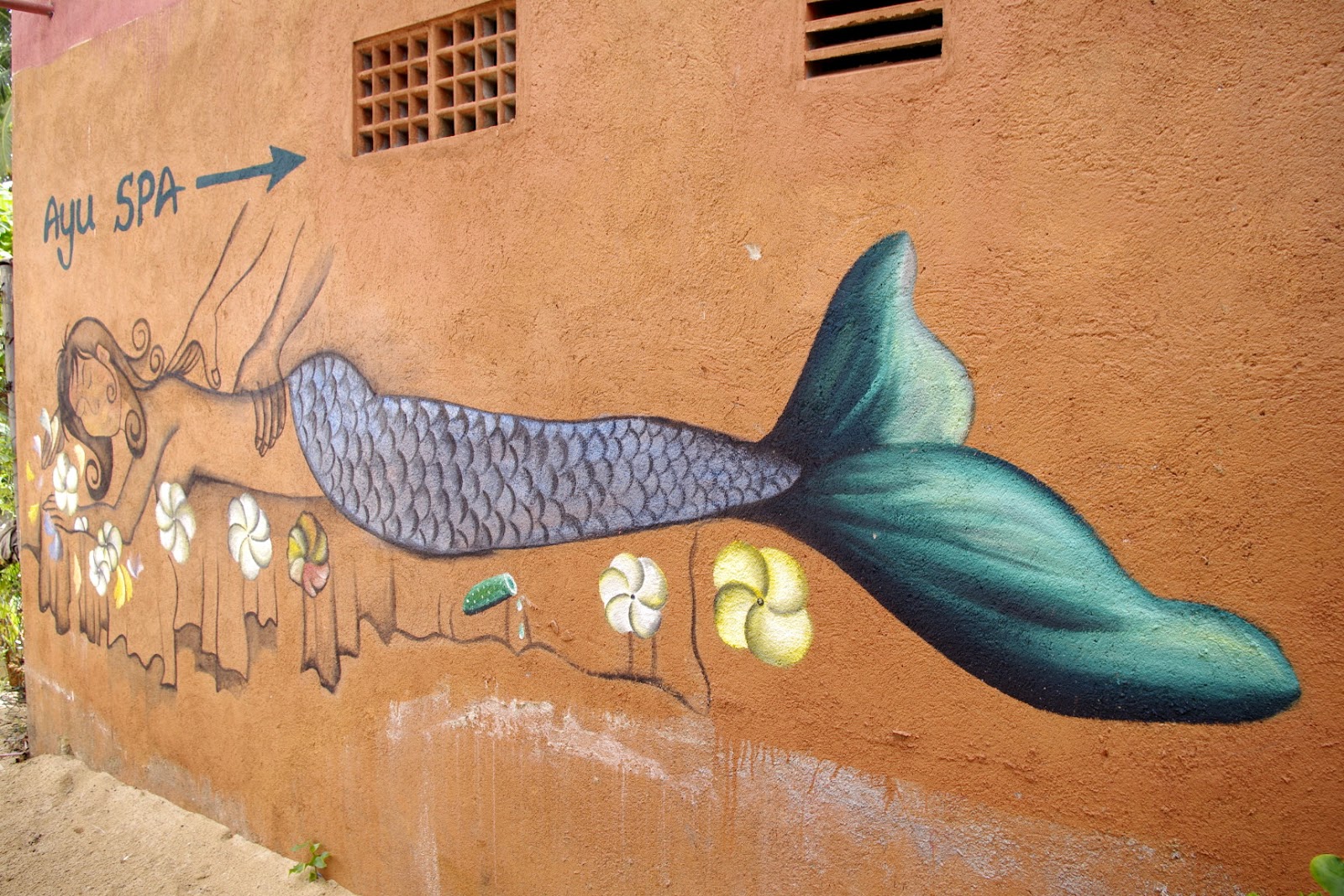 |
| Better advertising than most, but apparently a massage shop only for mermaids |
Having been a habitual traveller to southeast Asia, which flies out of LHR T3
(southeast Asian madness starts in T3 – there’s no need to fly anywhere), the smartness and efficiency and cleanness of T4
(Qatar Airways), came of something of a shock. Carpet tiles were not curling up
at the edges like exhausted sandwiches. Escalators escalated. Connecting
tunnels from the underground to the airport weren’t hospice grey. Unfortunately
I was flying with a pair of cargo pants that had lost their main button (Delli,
we need to talk), so had to shuffle through security, belt in the scanner,
clutching my trousers like I was about to be vigorously ill. The mother in
front of me, with three small’uns, was not impressed.
Wide-bodied London / Doha was easy, with a HUGE choice of
films and similar service to EVA, my normal carrier to Thailand. Amazingly both
my bag and I made the 45 minute transfer to the narrow-bodied Doha-Sri Lanka
jet, despite the inbound jet not stopping at a stand but at a bus stop. However
this second flight, starting at 3am my time, with no sleep, for another techy
4.5 hours, crammed full of screaming kids and Italians, was trying.

The point of travelling overnight was to ensure that I
arrived in Colombo in the morning, as the way to the conference, in Galle, in
the bottom left hand corner of Sri Lanka, was by bus. My hotel was in the middle
of not much and might need to be eyeballed if the bus chappies didn’t know where it
was. So, a first bus into a nearby town,
another into Colombo-proper, a third to Galle town in the southeast of the
country, and then a more tricky fourth to my hotel. When I say ‘bus’, these were
more like an ultra-low
tech fast-jet simulators, driven at the same speed and incurring the same
g-forces, but built for small Asians without luggage, without the need for any leg
room but plenty of sharp points and edges from the kneecaps down. The ubiquitous
horn was pointless – if you’re fast and big, other vehicles got out the way,
especially if the bus had just lurched into the middle of the road, over the
double solid white lines, overtaking on a blind corner. The hotel was somewhere
along the coast road, not in any town, so was a little tricky to find. However,
I met someone who knew all the hotels along the coast, of which there were
thousands, and finally got there, 5pm their time after ten hours of continuous
buses. Splitting dehydration headache and exhaustion was cured by diving into
bed and staying there until the next morning.
 |
| Establishing shot of Hotel |
 |
| South Beach Hotel at breakfast |
The conference venue had been moved with three weeks to go, from
a local uni to Long Beach hotel, Kaggala. Instinct suggested to keep it simple
and stay in this hotel. However at $140 a night, some complexity was needed.
Plan B, South Beach hotel was a fraction of the price and 1km away. Kushtie!
Surprisingly I was the only conference goer in this hotel. So the week was spent commuting up the coast
to listen to the great and the fabulous about the day jobs and dining
preferences of crabs, relative sea level change (finally I understand why it’s
complicated and site-specific), mangrove/salt marsh interaction, mangrove
dispersal modelling (way over my head), carbon fluxes, Ni pollution, the life’s
work of Philippine National Treasure Dr Primavera, seed dispersal testing, and
lots of geographic updates. Not quite my bag, but all really interesting and
some truly lovely people. It also has to be said that there were some dire presentations; long screeds of methodological detail mumbled inaudibly,
screaming for the only question that ever counts – SO WHAT?

Middle Wednesday was a field trip. The roads in Sri Lanka
are like writhing B roads in the UK, trying to get through a farming town
during market day set up. Moving round the island is slow and we had to start
Really Early. Three hours after meeting up, 10km north of my hotel, we drove
back past my hotel on the way to a blow hole, a developing sand-dune ecosystem
with entirely inappropriate intervention from a well-meaning NGO, a temple with
an amazing view, a driving break as the bus screeched to a halt so the busboy
could stuff a few rupees into a giant concrete chicken, two lagoon systems,
lunch at the Sri Lankan Small Fisheries Foundation and saw much of southern SL.
Particularly along the south coast there were terrible reminders of the
tsunami. Concrete floors of the base of houses, with only the squat toilet left
and everything else scoured away. Lots of gravestones. And of course frenetic
building in the same spots. Big learning for me: the bottom third of SL is very
dry and sandy. Surprised as the WHOLE of Thailand is wet and tropical, and
given 15 minutes of someone not trying to build on it, junglely. When it rains
it rains everywhere. But SL had quite different zones. So there was a lot of
thorny scrub, sand and empty space.

Thursday evening included a SL cultural evening, with traditional dancing.


On Friday evening, at the end of the conference, saying
goodbye to new friends and the splendid Dr Balaji (he who we helped, Loire
Valley Loungers) from India, who deservedly won the IUCN’s young
environmentalist award, many people headed a little way up the coast from
Kaggala where the conference was, to Unawatuna. Central along this bay was the very
nice Unawatuna Beach Resort. Arriving there late of Friday, for the last mass
drink, I asked if they had a room at the same time spotting a big Jag in the
car park. Thankfully they said, get lost little boy, and so I found the
charming Mr Sarnath running ‘Sunny Mood’ guest-house right behind it. No pool
but perhaps 10% of the cost of UBR (only tuktuks in his car park, and a sweet
if skinny Alsatian). Spent a very pleasant weekend recovering from the
conference and taking some pictures. New experience for me; seeing a turtle in
the wild. The beast came close to the beach, saw the swarms of full-sized
tourists flat out on loungers and thought better of it. But a turtle all the
same.
Monday meant heading north to just under Colombo to see
Abey, the boss of EMACE, an excellent little NGO doing childcare/orphan,
women’s rights, housing, mangrove rehab and other stuff. Changing buses in
Galle bus terminal, I asked the driver for Katubadda, Abey’s town. Wobble of
the head. Then I asked to be dropped outside a specific craft shop called
Laksala in Kutabudda. Another wobble. And good as his wobble, three freezing
cold hours later we lurched into the pavement right outside this shop, cutting
across the umpteenth tuktuk (whose lights ALL work! Anyone who has been to
Jakarta or India will appreciate what a novelty this is. On all the tuktuks,
ALL the lights worked. Stunning.) Abey came to pick me up and we had a very
pleasant lunch at his house.

Abey is a part time property developer, which pays for a lot
of the NGO activity. We met in Thailand in March as he attended the mangrove
training I delivered there with Jim of MAP. The new project that had paid for
the training was encouraging mangrove restoration in the participant countries.
So I offered to help Abey, as well as see what his NGO was up to. Their work
centres around Bolgoda Lake, 20k south of Colombo. Additional to the usual
problems inland lakes suffer from, this one has a huge furniture making
community on its slopes. Tonnes of sawdust is washed down into the lake when it rains, which
is also chock full of water hyacinth. EMACE had built an eco community
centre/guest house on the lake shore, with a couple of big Sonneratia mangrove trees right in front of the house, and I was to
stay here for a few days. The view from the balcony is beautiful, and we were 10
plots down from the oldest sailing and rowing club in Sri Lanka. As I type part
of this blog, various fours and sculls are slipping backwards across the lake.
But the sound track is of a terrifying amount of wood being cut up to make
furniture, all of which is uncomfortable. And these guys get their bandsaws
moving at 5am.
 |
| Just imagine a favella hillside, with narrow lanes, covered in yards like this |
The next day we drove round the lake to see their old
office, two mangrove nurseries and their proposed restoration site.
Interestingly, rather than being the usual trashed and cleared area, this is
full of fresh water grasses and huge invasives. Green, but not very productive
and no good for the fishermen. The next day I edited a document about this
project for Abey, and finished with an amazing boat trip round part of the
lake, with Saman who is the caretaker of this building. Skinny as a jockey, Saman
used to be… a jockey and has travelled the world working the horses and riding,
including a long time in Doncaster (!). Saman is an excellent cook, does all
the running repairs to the house, and looked after me royally. Sitting on
the balcony of the building, and while taking a little boat trip round part of the lake system, I’ve taken some slightly fuzzy pictures of loads of birds (yes I know,
Benjol, tripod…), seen a pelican, sea eagles, watch two mongoose chase each
other like squirrels, witnessed two 7 feet non-poisonous snakes dance for 15
minutes while personally feeding the hungry appetites of possibly hundreds of
thirsty mosquitoes.


Abey and EMACE done, the third week was supposed to include
a meeting with a mangrove guy in the Environment Dept and a familiarisation
with Colombo. Sadly this meeting was canned, and as SL is a bit more expensive
than I hoped, rather than heading south for a holiday, I changed the return
flight and headed home early. There’s still plenty to see. The northeast has
had no development work for 30 years (just watch your step!). Kandy and the central
highlands are another place that should be seen. However, as a non-earning,
self-funded student,… The return was easier,
apart from having to start the first leg at 4.25am. Thankfully, this flight was
only two-thirds full and on time, so the transfer onto the similarly 2/3rds
full flight from Doha to London was easy, and the pre-Olympics LHR very
efficient.
The flying time gave an opportunity to reflect on SL: the
strange feature of constant sea spray mist in the air along the west coast
corroding everything in its path; the Sri Lankans themselves who were very
friendly; the technical difficulties of restoring a EMACE’s mangrove site with
a very low tidal range of perhaps 50cm; the still-palpable relief at the ending
of the war with the resulting apathy about the post-Soviet-style asset grab by
the president and his family who control 75% of the economy; the mixed feeling about
Colombo and what it might be like to live there; those bloody mozzies and that
despite the marvellous George (brother-in-law) being back in Crete, I’m glad to
be home.

Please follow the picasa link if you would like to see all the
pictures.
https://picasaweb.google.com/111581195668547069776/SriLanka2012MMM3?authkey=Gv1sRgCKawvtiPudr6jwE
Thanks for reading.
https://picasaweb.google.com/111581195668547069776/SriLanka2012MMM3?authkey=Gv1sRgCKawvtiPudr6jwE
Thanks for reading.
Subscribe to:
Posts (Atom)

